April 25

Week 12: Update (II) Save Tuba Business Model Canvas & Revenue Model

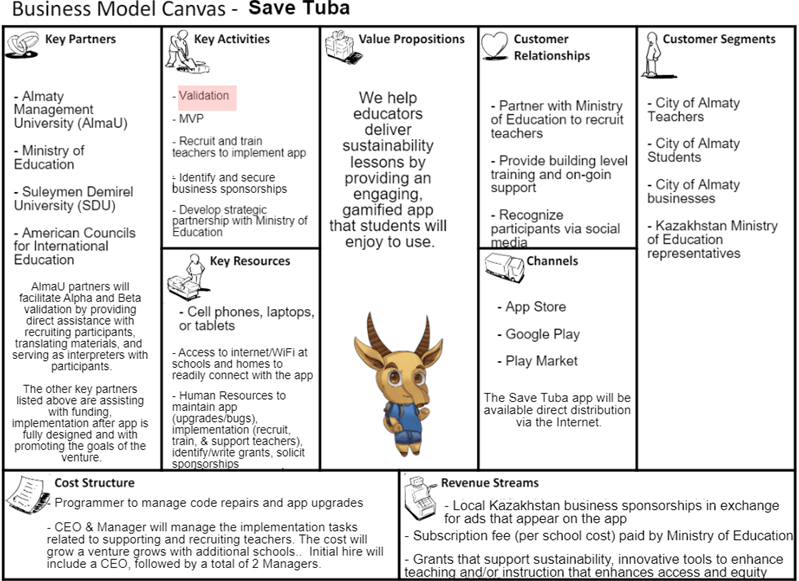
Update II – Save Tuba Business Model Canvas (as of 04.25.21)
How will we deliver an end-to-end solution?

The Save Tuba app provides a comprehensive tool for teachers and students.  Upon downloading the app, users will have all they need to navigate through the lessons and activities.  The learning can be extended via engaging activities and real-life applications of the concepts learned.  Students can take pictures with their device and easily integrate the evidence of their activity via the app.  Teachers, also via the app, will have access to a dashboard that will provide information about the individual user’s status with the various activities, assessments, and general progress through the levels.

Update II – Save Tuba REALISTIC Revenue Model (as of 04.25.21)
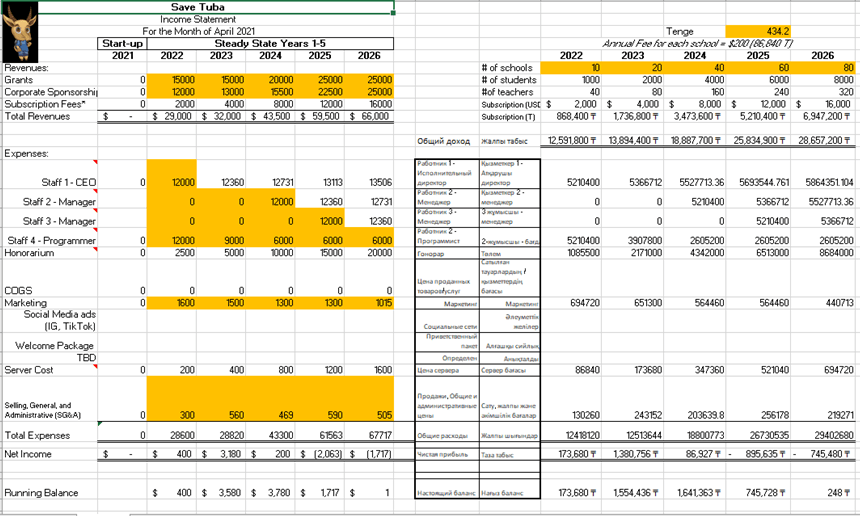
Update II – Save Tuba OPTIMISTIC Revenue Model (as of 04.25.21)

Update II – Save Tuba PESSIMISTIC Revenue Model (as of 04.25.21)

Ten practical lessons from the business (revenue) models of ventures we reviewed in class or  researched as they relate to our venture.

  1. Look into multiple sources of revenue stream to make the app more affordable for institutions. Along with subscriptions, getting sponsored by companies who are trying to create an image of being green would help both parties.
  2. Personalize the app to its region.  Creating a targeted app will make the app more compelling for school administrators and school-aged children will find it engaging and relatable to complete the tasks. But most importantly, we can tap into local businesses who would be willing to invest into our project so that the tasks inside the app also have a connection to the local business.  Thus, increasing the probability for sponsorships.
  3. Incentivizing a few teachers in each school to become the apps ambassador in their respective institution will help create a foothold for our project and will help us train new teachers quickly and efficiently.
  4. Host special weekly or seasonal in app events which will have tasks that give certain sponsored companies exposure. We should however maintain the apps ethics and integrity while choosing which companies can be a part of our program.
  5. We made a store for our character “Tuba” where students can buy shirts and hats in exchange for coins they collect by completing levels. We can have sponsored merchandise in store which can be given out during special events or can be exchanged using coins.
  6. It’s important for us to keep in mind that we didn’t draft our current business model for the sole purpose of completing a class assignment (i.e., it will serve as the foundation of our venture and we need to keep adding to it over time). For example, the revenue and costs as they relate to the students and teachers in Kazakhstan are not set in stone yet, since at this stage of our venture we are not sure how many schools we are going to be reaching out to. Once we develop a clearer idea, we are going to have to revise our business model.
  7. To add to the previous point of how our business model isn’t just a one-time assignment, we need to work on our revenue-generation plan over a longer period of time to make sure that it is as realistic as possible.
  8. What makes our current BM really strong is its simplicity, in that anyone could take a look at it and immediately figure out how our venture operates, how we are going to be generating revenue and staffing the venture, etc. It would be great if we could keep this up when adding to our BM in the future.
  9. Our team needs to do more research on the educational app market (e.g. determine who our main competitors are). This would prove to be especially beneficial for those of us who are working on developing the app, be it in terms of gaining inspiration from other successful ventures (looking at what they’re doing right and implementing it) or taking note of whether their technology is more advanced than ours/what we can do to make sure that we are on par so as to stay in business.
  10. Lowering costs would boost our revenue. While we’re trying not to be stingy with the money that we’re paying the venture’s management team, we need to work on reducing our marketing, server and SG&A costs as much as possible.
April 19

Week 8: SKS Collaboration Plan

Summary and report out on the results of the SKS exercise

Start

  1. Drafting an agenda on what we’re going to be discussing at our group meetings
  2. Writing a list of things that we hope to accomplish (individually and as a team) each week
  3. Keeping tabs on all of our accomplishments on a google doc so that every team member is up to date with what the others are doing

Keep

  1. Meeting on a regular basis 
  2. Communicating with each other throughout the week and not just during meetings or class time 
  3. Paying close attention to the ideas and inputs of each team member 

Stop 

  1. Mixing zoom links up 
  2. Forgetting to show up to meetings
  3. Leaving blog assignments for the last day

Save Tuba’s detailed Collaboration Plan for our team clearly articulating our                 Goals (Small g and Big G), Roles, Procedures, and Relationships.

Small goals 

  1. Diana: Focus on developing coding skills, garner a slightly more advanced proficiency of Russian, keep up with what the team is working on outside of app development
  2. Rubiat: Focus on developing coding skill sets to implement new features to the app and improve user experience along with having clear communication with team members outside of the app development.
  3. Yamil: Ensure Alpha validation focus groups are completed with designed protocols

Big goals

  1. Come up with a clearer plan for beta testing process
  2. Work on getting the first four levels of the app in before the end of the semester
  3. Come up with better metrics to assess the short-term impact of the app

Roles 

  1. Diana: Works on coding the app, cultural specialist (understands Kazakhstan’s educational system/the general mindset of the people)
  2. Rubiat: Works on coding the app, Works closely with the design team.  
  3. Yamil: Design beta validation protocols to ensure a successful and efficient use of the limited time during the in-country experience

Procedures

  1. Have a team member take notes in a shared google doc at every meeting, and assign clear action items to people so that things get done before the next meeting.
  2. Make decisions by having discussions with the whole group and reach a consensus.
  3. Communication methods:
    • Share all documents in Google Docs
    • Communicate through GroupMe
    • Meet over Zoom on Mondays, Tuesdays and Thursdays 

Relationships

  1. Spend some time talking about topics that aren’t necessarily related to the venture during meetings
  2. Ensure that every team member feels comfortable sharing their opinions
  3. Make an effort to socialize outside of an academic setting (e.g. meeting up for lunch once we’re all on-campus)
  4. Be mindful of the potential scheduling difficulties/time zone differences of each teammate, and brainstorm ways to work around them such that everyone gets to attend the meetings
April 11

Week 10: Total Available vs. Addressable Markets

Five compelling takeaways from the Art of the Start

  1. Make meaning. Successful companies start out to make meaning, not to make money.   Companies make meaning by:
    1. Increasing the quality of life
    2. Right a wrong
    3. Prevent the end of something good
  2. Create a mantra. Be able to answer “why do you work here”?  Some guidelines for drafting the mantra include:
    1. Avoid it being too long, not unique, not memorable
    2. 3 or fewer words ie: Healthy fast food can be the mantra for Wendy’s
  3. Get going. As an entrepreneur we should think differently or aim to deliver an already known idea/service better than the competition.  During the journey, we shouldn’t be afraid of polarizing people with our venture since it is not possible to please all people.  If you attempt to do so, you end up creating mediocracy.  Finally, it’s important to create a team (soul mates) that balance you as the entrepreneur.
  4. Business model. Work at clearly defining a business model that is:
    1. specific  – answer: Who is my customer? How do I get my money out of his wallet/her purse?
    2. Simple – there is no need to innovate on business model.
    3. Ask women about business models! Do so since men have a fundamental flaw of wanting to kill things.
  5. Hire infected people. It’s important to build your team with individuals that have the work/educational experience needed AND who also LOVE your product!  Build your team with individuals who are better than yourself. Finally, apply the shopping center test – if you don’t get the I want to go over there feeling because you like her/him, don’t hire that individual.

One last and important takeaway is to not let the bozos grind you down!


Save Tuba’s value proposition for our diverse customer segments!

The Save Tuba app is a creative tool that helps bring sustainable education to life. It is an interactive way to engage children and educate them on sustainability. Rather than learning from lectures and tests, we are giving our users a way to escape from their classrooms and explore their local communities in order to make them greener. They will not only be educating themselves but also their parents as parents are often involved in their child’s education.

The value proposition for our diverse customer segments is that we help educators deliver sustainability lessons by providing teachers an engaging, gamified app that students will enjoy as they learn and apply the lessons learned into real-life behaviors.


Save Tuba’s Total Available Market and Total Addressable Market

(Lists of our assumptions and hypothesis)

Our Total Available Market hypothesis is that once customized to the different grade cohorts and (if and when) proven to be effective via implementation with Lower secondary students, the Save Tuba app will be included in all public, private, and Ministry schools with teachers and students in Kindergarten through 11th grade.

The Total Available Market and Total Addressable Market are based on the following assumptions:

  1. Save Tuba app will be customized to serve all school-age groups (Kindergarten, elementary, middle, and high school students in Kazakhstan).
  2. The Ministry of Education in Kazakhstan will approve the implementation of the Save Tuba app across the entire country.
  3. District and building level administrators will support classroom teachers with implementing the Save Tuba app.
  4. All teachers will adopt the use of the Save Tuba app when teaching sustainability lessons.
  5. All students will have the necessary equipment (mobile device – cell phone, tablet, laptop, or desktop) to access the Save Tuba app.
  6. All students will have access to WiFi/Internet to be able to connect to the Save Tuba app at their school and/or home.
  7. Once implemented with Lower secondary students, the Save Tuba team will be better able to expand the adoption into Primary and Upper secondary schools.
  8. We assumed an average of 25 students per teacher.

Our Total Available Market is ~3,557,856 students (~142,314 teachers) attending public, private and Ministry of Education schools in grades K – 11. 

  • 8,575 elementary and secondary schools (grades one through eleven) 
    • approximately 3.2 million students
  • 244 specialized secondary schools 
    • approximately 222,000 students
  • 100 kindergartens (83 public, 4 directly under the Ministry of Education, and 13 private) 
    • 135,856 children enrolled in kindergartens (or 63% of the 5- and 6-year-olds)

Of the Total Available Market in Kazakhstan, the number of students and teachers that we can realistically reach is based on working with students and teachers from Lower secondary schools (grades 5-9) in the City of Almaty. Our Total Addressable Market is a subset of the Total Available Market. It will include 20 schools, 16,000 students and 640 teachers.

April 4

Week 9: Reflecting on our 2021 Spring Mid-term Save Tuba Presentation

Identify five things you could do better with your seven-minute presentation.

  1. Slide design – the slide design could be improved to make the presentation more easier for the audience to follow and understand.
  2. Better articulate our metrics of success.
  3. Amount of information in the presentation – We had too much information in our presentation, so we lost audience’s attention a bit
  4. Pace of the presentation – The presentation felt a bit rushed at the end since we did not manage well the seven minute limit.
  5. Ending of our presentation – our presentation would’ve been more effective if we had an ending slide which would summarize our most important messages.

Did you respond to the referees’ questions in a concise and precise manner? Describe five responses you could have approached differently.

  1. Some of the main concerns that the judges expressed had to do with the infrastructure aspect of our venture (i.e., how we will not be able to see a spike in recycling despite the peoples’ efforts if there is no infrastructure in place). Our team knew the answer to this question but were not concise enough when it came to elaborating more on it, and it seemed as though the judges did not receive any genuine clarification. If we had elaborated on this more (e.g. specify that the government is investing millions of dollars into recycling infrastructure already), it would have greatly benefited our overall presentation. For our final presentation, we will try to include a slide on this part of the venture, as well as rehearse more concise responses. 
  2. Most of the judges struggled to understand how implementing our app in classrooms would lead to short-term and long-term change, and we did not have enough time to cover everything that we wanted to say about this topic. It would have been wise to sacrifice some of the more irrelevant content in our presentation in favor of deeper explanations regarding the logistics of our venture, instead of saving all of our information for the Q&A session. 
  3. Generally speaking, our team was getting slightly flustered at some points, as there were a few questions that we hadn’t anticipated or practiced answering beforehand. Now that we have a clearer idea of what will be asked at our final presentation, we should have an easier time coming up with FAQs and anticipating the judges’ questions. 
  4. Most of the student feedback that we received had to do with a) the answers not being evenly distributed among the team members  b) us being confused as to who was going to answer which questions. We will try to be mindful of these comments at our next presentation and make sure that everything is structured better. 

Identify five techniques / strategies (content, design, answering questions, etc) that other teams did particularly well…that you could adopt for your own team.

The following are five strategies well executed by other teams that Save Tuba will look to incorporate into our future presentations:

  1. Final slide – a couple teams finished their presentations with a slide that summarized/listed the title and order of their backup slides. That final slide provides the audience with a list of categories of additional available information and it helps the team know what slide they would need to quickly move to assist answer a question posed.
  2. Pace of presentation – Some teams’ (i.e. Air Quality Almaty) presentations demonstrated that they mastered a steady and not hurried pace when delivering their message.  These teams created a good balance with the amount of talking that was well coordinated with the number of slides in their presentations.  A key lesson learned was that we tried to deliver too much content, both with our verbal presentation and the number of slides. 
  3. Clarity of slides – The PowerPoint slides from some of the teams (i.e. PlasTech Ventures, GRO Mushrooms, Mothers of Sierra Leone and Sickle Cell Diagnostic) were visually appealing and easy to understand. The slides had a simple, yet sleek design that conveyed the critical information without too much text. Although some of our slides were able to accomplish this design feature, one critical slide that seemed to have failed was the Timeline slide, which had too much information (visuals and text).  We will look to replicate the clarity that other teams accomplished by simplifying that slide to similarly be simpler and project a sleek design.
  4. Leverage lessons learned – Zero College Hunger, specifically, demonstrated how they used lessons learned from other similar ventures (albeit in other countries) to inform their project. The importance of being able to accomplish this is underscored by the suggestion offered from a referee at the end of our presentation to learn from what other apps have done to address the hurdle with needing to translate the app.
  5. Fielding questions from the referees – several teams worked like a well oiled machine when fielding questions.  Individuals from their perspective team knew when to answer a question with little hesitation or wasted time to offer a response.